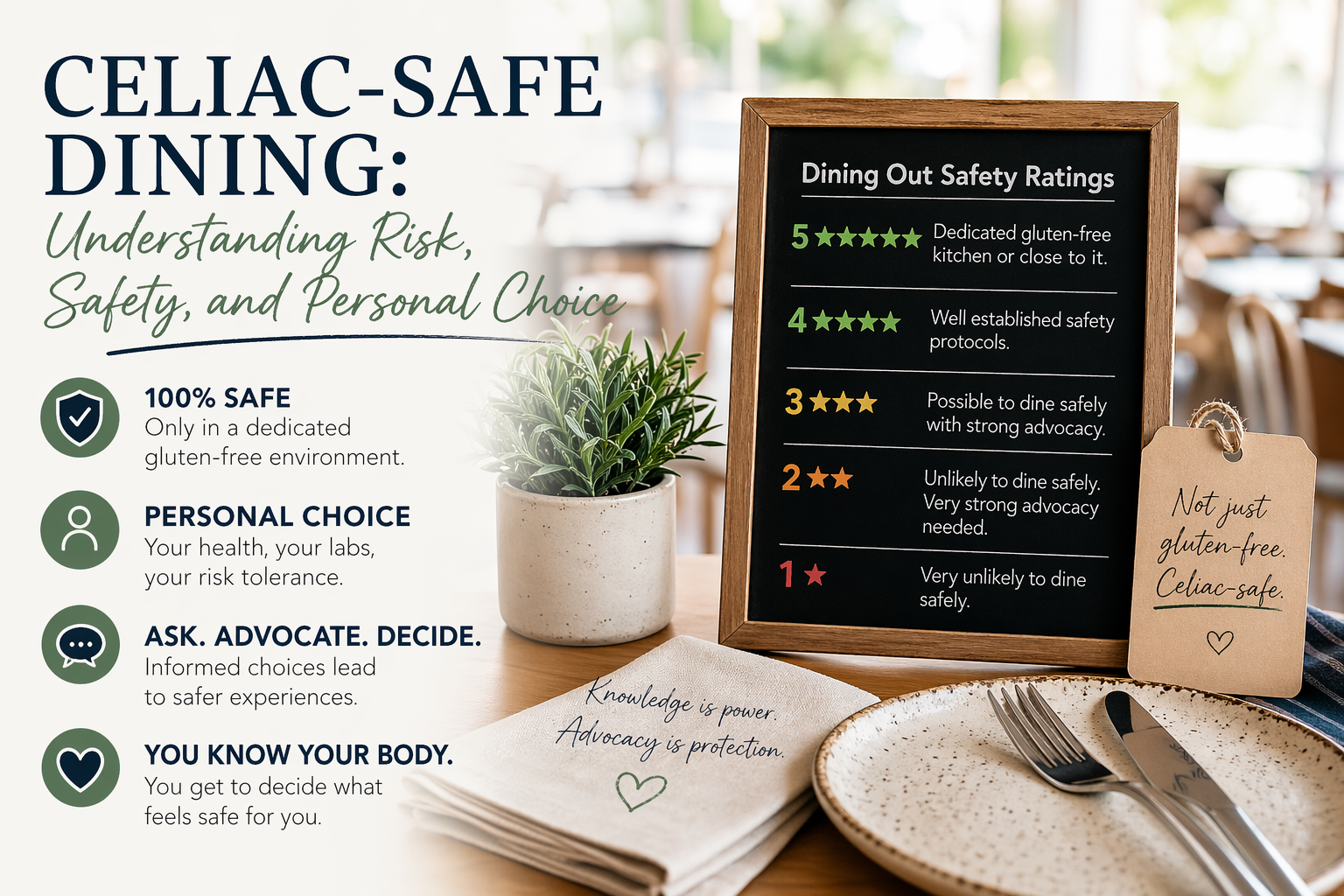
Celiac-Safe Dining
Understanding Risk, Safety, and Personal Choice
“Celiac Safe”- If you have celiac disease, you’ve likely heard this before, but it’s worth saying clearly:
The only way to be 100% safe when dining out is in a dedicated gluten-free environment.
That means a kitchen where no gluten containing ingredients are used, significantly reducing (or eliminating) the risk of cross contact.
But here’s where things get more nuanced…
Safety Isn’t One-Size-Fits-All
Despite that reality, people with celiac disease dine out in a variety of settings every day. Why?
Because every person with celiac disease navigates risk differently.
What feels safe or acceptable for one person may not feel safe for another. And neither approach is “right” or “wrong”, it really comes down to your health and personal preference.
Your personal approach is often shaped by:
Medical guidance from your doctor
Whether you are in remission
Your most recent celiac lab results
Symptom severity and sensitivity to cross contact
Your lifestyle, access to food, and support systems
Experience
For some, strict avoidance outside of dedicated spaces is non-negotiable. For others, there may be situations where a calculated level of risk feels acceptable. I’ve noticed that sometimes there can be judgment around how people navigate their health, let’s all try to approach each other with a little more understanding (myself included).
This is personal, and it should be informed, not judged.
What Does “Celiac-Safe” Actually Mean?
“Gluten-free” does not always mean celiac-safe.
A restaurant may offer gluten-free options, but still prepare food in a shared kitchen with:
Shared fryers
Shared prep surfaces
Cross-contact through utensils or equipment
Staff who may not fully understand the severity of celiac disease
That’s why understanding levels of safety can be helpful when making dining decisions.
A Helpful Framework for Dining Risk
Apps like Find Me Gluten Free and Fig provide a useful way to think about safety through community reviews and ratings. While not perfect, they offer a general framework for assessing risk. Below is how FMGF defines ratings for safety:
️ 5 – Dedicated Gluten-Free (or Very Close)
Fully gluten-free kitchen, or extremely strict separation
Minimal to no risk of cross contact
Staff is highly knowledgeable about celiac disease
Clear protocols are in place and consistently followed
This is the closest you’ll get to “safe” dining outside your home.
️ 4 – Strong Safety Protocols
Non-dedicated kitchen, but with well-established procedures
Separate prep areas, equipment, and cooking methods
Staff understands gluten, cross contact, and severity
A solid option for many—but still not zero risk.
️ 3 – Possibly Safe with Strong Advocacy
Some awareness of gluten-free practices
Inconsistent knowledge among staff
Safety depends heavily on your ability to advocate
You may need to:
Ask detailed questions
Clarify preparation steps
Request modifications
This level comes with increased uncertainty.
️ 2 – Unlikely to Be Safe
Limited understanding of cross contact
Shared cooking environments with minimal safeguards
Requires very specific ordering and strong advocacy
Higher risk—often not worth it.
️ 1 – Not Safe
Little to no understanding of gluten-free needs
High likelihood of cross contact
No meaningful accommodations available
Best to avoid.
The Role of Self-Advocacy
Dining out with celiac disease often means becoming your own advocate.
This can look like:
Asking how food is prepared (not just what’s in it)
Confirming separate fryers, surfaces, and utensils
Explaining cross contact in clear, simple terms
Being willing to walk away if something doesn’t feel right
And let’s be honest—this can be exhausting.
It’s not just about food. It’s about:
Navigating social situations
Not wanting to “be difficult”
Balancing safety with quality of life
Risk vs. Quality of Life
This is where things get deeply personal. Some people choose to only eat at home or in dedicated gluten-free spaces. Others occasionally take calculated risks in order to:
Travel more easily
Participate in social events
Feel a sense of normalcy
Neither approach is inherently better. What matters is that your decisions are:
Informed
Intentional
Aligned with your health needs, including your mental health
Mental Health Matters Too
During Mental Health Awareness Month, it’s especially important to recognize that living with celiac disease isn’t just physical, it’s deeply mental and emotional, too. Every decision around food safety comes with a level of vigilance, planning, and, at times, anxiety. Constantly assessing risk, advocating for yourself, and navigating uncertainty can be exhausting. For some, strict control over food environments brings peace of mind. For others, that same level of restriction can feel isolating and limiting. Social events, travel, dating, and even spontaneous meals can become sources of stress rather than enjoyment. This is where mental health and physical health intersect. Your approach to celiac safety may shift depending on burnout, anxiety levels, support systems, and overall well-being. Finding a balance between protecting your health and maintaining a fulfilling, connected life is not always easy, but it is important. Your mental health is just as valid as your physical health, and both deserve to be part of the conversation when deciding what “safe” looks like for you.
A Note on Medical Guidance
Your doctor’s recommendations should always play a role in how you approach dining out.
If you’re unsure where you stand, consider:
Checking your celiac antibody levels
Discussing symptoms (or lack of symptoms)
Talking through risk tolerance and lifestyle considerations
Your internal health matters, even when symptoms aren’t obvious.
Final Thoughts
Celiac-safe dining isn’t black and white, it exists on a spectrum.
While the only truly “safe” option is a dedicated gluten-free environment, the reality is that many people make choices along that spectrum every day.
This isn’t about fear or judgment. It’s about awareness, education, and autonomy.
You deserve to:
Understand your risk
Make informed choices
Feel supported in how you navigate your health
Because at the end of the day…
What feels safe for you is yours to define.