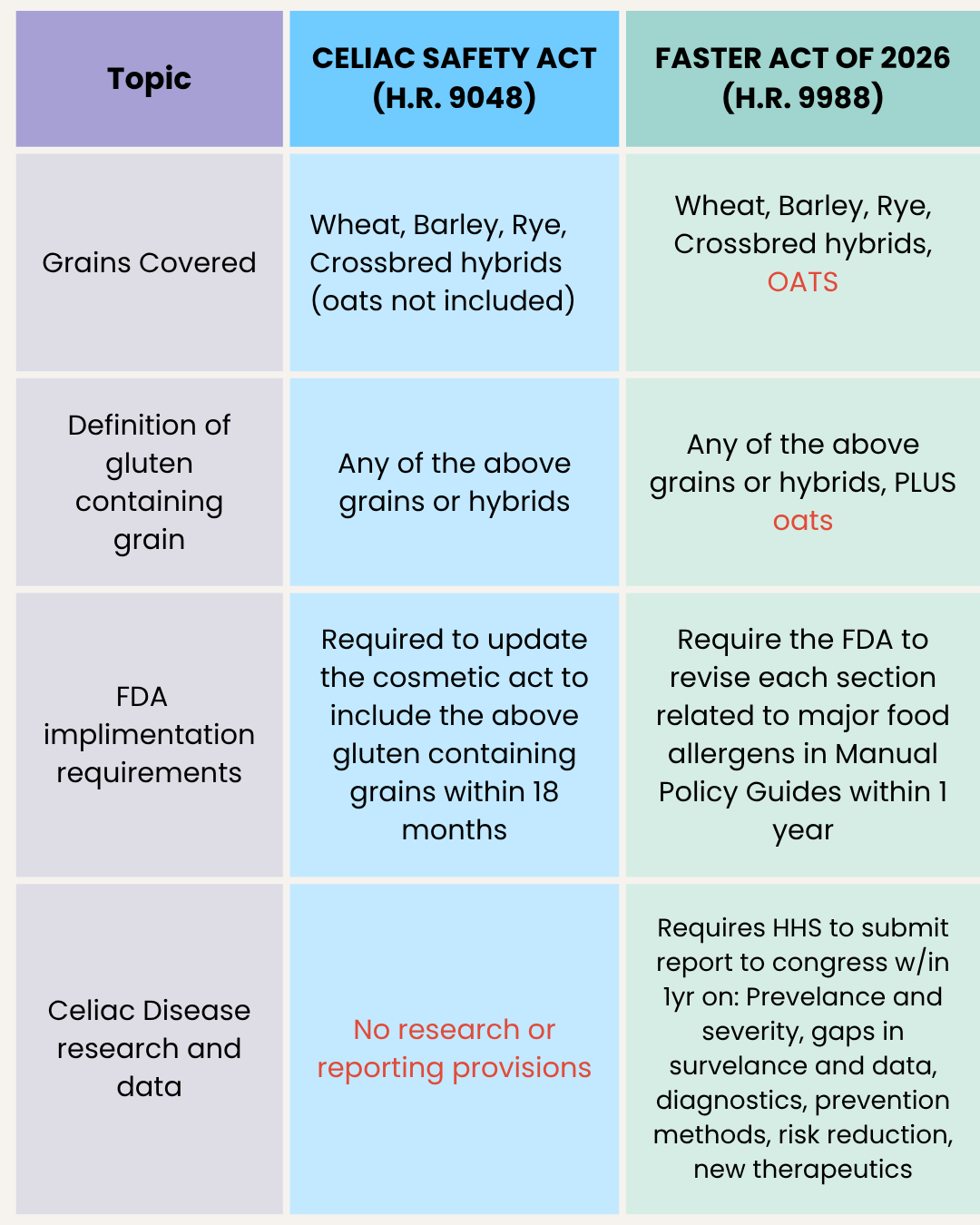
Comparing the FASTER Act of 2026 to The Celiac Safety Act
Congress Introduced the FASTER Act of 2026 (H.R. 9988). We Already Have the Celiac Safety Act (H.R. 9048). While both bills aim to improve food labeling and safety for people with celiac disease, they take different approaches. The most notable difference is oats.
The Biggest Difference: Oats
The FASTER Act defines gluten-containing grains as including:
Wheat
Barley
Rye
Oats
This is similar to the approach taken in the UK and several other countries that include oats within their legal framework for gluten labeling. Including oats is something I thoroughly support and have advocated and written about.
The Oats Issue
Current U.S. Standards
The FDA allows foods containing oats to carry a gluten-free label if they contain less than 20 parts per million (ppm) of gluten. This 20 ppm threshold is consistent with both the UK and the European Union.
However, the FDA does not require manufacturers to routinely test either their ingredients or finished products before making a gluten-free claim. Instead, manufacturers are legally responsible for ensuring their products contain less than 20 ppm of gluten and do not contain prohibited grains.
At present, a product may carry a gluten-free claim even though it is produced on shared equipment without adequate cross-contact controls or has never undergone finished-product testing. The current framework places responsibility on manufacturers to ensure compliance, but I believe additional guidance, oversight, and standardized validation requirements would strengthen consumer confidence.
How Does This Compare Internationally?
More than 85 countries require gluten to be declared as an allergen on food labels, following the Codex Alimentarius Commission. The Codex Alimentarius, or "Food Code" is a collection of standards, guidelines and codes of practice adopted by the Codex Alimentarius Commission. The Commission, also known as CAC, is the central part of the Joint FAO/WHO Food Standards Programme and was established by FAO and WHO to protect consumer health and promote fair practices in food trade. It held its first meeting in 1963. Codex standards ensure that food is safe and can be traded. The 188 Codex members have negotiated science-based recommendations in all areas related to food safety and quality. For the purpose of the Codex, "gluten" is defined as a protein fraction from wheat, rye, barley, oats or their crossbred varieties and derivatives thereof, to which some persons are intolerant and that is insoluble in water and 0.5M NaCl.
Gluten labeling is specifically included in: Canada, Brazil, Australia, New Zealand, and the 27 member states of the European Union. Canada requires more specific definitions and labeling requirements for gluten free oats, an area where I believe the United States is lacking. The UK also takes a more defined approach. Oats remain within the legal framework of a gluten definition because of the ongoing research and the risk of contamination.
Under UK and EU law:
Pure, uncontaminated oats may be labeled gluten-free if they contain 20 ppm or less of gluten.
Mechanically sorted oats seem to be allowed for gluten-free products but with potentially more oversight and regulation.
Oats are still allowed on products labeled gluten free. Even when certified or labeled gluten-free, the word "oats" must still be emphasized (such as in bold) within the ingredient list to comply with allergen labeling laws.
Like the United States, manufacturers remain responsible for ensuring their products meet legal requirements. However, there appears to be strict penalties for misbranding gluten-free products in the UK, something I have not seen widely enforced in the United States. At present, a product may carry a gluten-free claim even though it is produced on shared equipment without adequate controls, or has never been properly tested.
Something interesting to note, under UK and EU law, pure uncontaminated oats can be labeled "gluten-free" as long as they test at 20 parts per million (ppm) or less of gluten, despite oats legally remaining a declared allergen (20 ppm is the international standard). Even when certified or labeled gluten-free, the word "oats" must still be physically emphasized (such as in bold text) in the ingredient list to comply with UK allergen laws. This is similar to how products may contain wheat (gluten free wheat starch) and still have a gluten free label but have a contains wheat statement. How will the USA handle gluten free labeling and oats with this provision, particularly with the requirement for the FDA to update manuals? Comparatively, Australia and New Zealand allow no detectable gluten to be labeled gluten free and do not allow oats to be present. I don’t know the answer, but this is where the research requirement of this bill will be invaluable.
Why Oats Matter
From an advocacy standpoint, oats present several unique challenges:
Many people with celiac disease choose to avoid oats.
Oat contamination remains an ongoing concern, with an increased risk for mechanically sorted oats over purity cropped oats.
Oats contain a protein called avenin, which a small percentage of people with celiac disease react to.
Consumers frequently assume oats are automatically safe.
Requiring oat disclosure could improve awareness and help consumers make more informed decisions.
A Potential Legal Challenge
Scientifically, oats are not considered gluten-containing grains in the same way as wheat, barley, and rye.
By legally defining oats as a "gluten-containing grain," the FASTER Act could create tension with existing FDA gluten-free regulations. Whether the FDA could reconcile that without additional amendments isn't clear from the bill itself.
One possible solution would be to better define why oats are being included.
The UK's Food and Drink Federation explains it this way:
"Most people with intolerance to gluten can include oats in their diet without adverse effect on their health; however, due to ongoing research and the contamination risk from other cereals containing gluten, oats are deemed cereals containing gluten within law. Additionally, certain proteins (including non-gluten proteins) found in cereal grains may also trigger allergic responses."
For clarity, "cereals" in this context does not refer to breakfast cereal. It refers to edible grasses grown for their starchy grains, including wheat, rye, barley, and oats. They also clarify that, for the purposes of labelling prepacked foods, cereals containing gluten include oats.
I think language like this better explains the rationale for including oats without implying that oats inherently contain gluten.
Two Different Policy Philosophies
The Celiac Safety Act (H.R. 9048)
The Celiac Safety Act takes a scientifically precise approach. It says the allergen category should include the grains that actually contain gluten:
Wheat
Barley
Rye
Hybrid grains (such as triticale)
It does not attempt to solve the oat problem. We really, really want the oat problem addressed.
The FASTER Act (H.R. 9988)
The FASTER Act appears to take a broader consumer-protection approach.
Instead of asking:
Which grains biologically contain gluten?
It effectively asks:
Which grains create a meaningful gluten-related risk for consumers with celiac disease?
Because in the United States:
oats are frequently grown, transported, milled, and processed alongside wheat, barley, and rye;
the FDA has recently sought additional information regarding oats and gluten contamination;
some manufacturers, such as Cheerios, rely on mechanically sorted oats rather than purity protocol oats, which has been controversial within parts of the celiac community; and
other countries have adopted more defined approaches to oat labeling than the United States.
From that perspective, including oats isn't necessarily saying "oats are gluten." It may instead be saying "oats should receive the same disclosure requirements because they present a comparable labeling concern."
Celiac Disease Is Not An Allergy
One additional area I would encourage lawmakers to revisit is the terminology used in the research section of the FASTER Act. The bill refers to celiac disease as causing an "allergic reaction." While this language is commonly used in everyday conversation, particularly when people with celiac disease explain the seriousness of gluten exposure to restaurants or food service staff, it is not scientifically accurate.
Celiac disease is an autoimmune disease, not a food allergy. Gluten exposure triggers an autoimmune response that damages the small intestine rather than an IgE-mediated allergic reaction. Because legislation often serves as a reference for future policy, research, and public education, I believe it should reflect the correct medical terminology whenever possible.
If lawmakers choose to use allergy terminology for the purpose of allergen labeling and consumer protection, I would recommend making that distinction explicit. For example, language clarifying that gluten-containing grains are subject to allergen disclosure requirements for the purposes of this Act would preserve the intent of improving consumer safety without inaccurately redefining celiac disease as an allergy.
This is similar to my recommendation regarding oats: the policy objective makes sense, but the legal language should clearly explain why these provisions exist. Precise terminology not only improves the scientific integrity of the legislation but also reduces the potential for confusion in future interpretation and implementation.
Where I Think the Bill Could Be Improved
I think the intent of the FASTER Act makes sense, but the legal wording could be improved.
For example, I would consider language such as:
"For purposes of allergen labeling, oats shall be subject to the same disclosure requirements as gluten-containing grains due to the potential for gluten contamination."
That would preserve the consumer-protection goal without implying that oats inherently contain gluten.
I would also like to see (whether it's appropriate for this bill or not):
Stronger oversight and clearer criteria for how manufacturers demonstrate compliance with the 20 ppm gluten-free threshold.
Explicit requirements that wheat, barley, rye, and oats be individually disclosed rather than simply labeled as "gluten."
Greater clarity regarding how gluten-free labeling will apply to products containing oats.
Additional labeling distinctions such as "Gluten-Free (Mechanically Sorted Oats)" or "Gluten-Free (Purity Protocol Oats)" to better define the level of risk associated with oat ingredients.
Correct the terminology in the research section to refer to autoimmune reactions, immune-mediated responses, or simply adverse health effects associated with celiac disease instead of “allergic reactions.”
We might find that some products that were labeling themselves as gluten free no longer do so if this new FASTER Act passes. That doesn’t need to be a bad thing, it makes it safer and is more consistent with how other countries are already functioning based on science. Clear, accurate labels lead to informed choices. Whether someone chooses to avoid oats entirely, consume only purity protocol oats, or eat any product that meets the gluten-free standard should be a personal decision—not one made because labeling failed to provide enough information.
The Research Addition
The research addition has the potential to have a huge impact but I wonder if it will make the legislative path more complicated? Research can potentially broaden the scope which can invite future amendments. Would this then authorize new funding? That could be a huge asset to celiac disease research and progress but what hurdles does that impose? The long term impact is undeniable, but if we are talking about getting gluten labeled sooner rather than later, the celiac safety act has some more immediate impact.
Organizing My Main Questions
My main questions are:
How will this impact gluten free labeling with products that contain oats
If oats are still able to be considered gluten free if they contain under 20 ppm, what kind of oversight or regulation will help determine appropriate gluten free labeling with oats
Will allergen labeling now read “contains gluten” or will the specific allergen be listed?
Final Thoughts
Overall, I support the intent of strengthening gluten allergen labeling and believe this legislation has the potential to significantly improve safety and transparency for consumers. At the same time, I hope Congress and the FDA continue refining the language to address several important implementation questions. In particular, I would like to see clearer statutory language regarding oats and their cross-contact risk, stronger oversight and standardized criteria for how manufacturers demonstrate compliance with the 20 ppm gluten-free threshold, and explicit requirements that wheat, barley, rye, and oats be individually disclosed rather than simply labeled as "gluten."
I also believe additional clarity around gluten-free oat labeling, such as identifying products made with mechanically sorted oats or purity protocol oats, would help consumers better understand the level of risk and make informed decisions based on their individual needs. Ultimately, clearer, more transparent labeling empowers consumers, supports informed choice, and strengthens trust in the food supply.
Both bills represent meaningful progress toward improving transparency for people with celiac disease. The Celiac Safety Act takes a scientifically precise approach by focusing on the grains that inherently contain gluten, while the FASTER Act takes a broader consumer-protection approach by recognizing that oats can present a significant real-world labeling challenge. If I have to pick one, the FASTER Act is more beneficial for celiac disease consumers. The fact is, the FASTER Act aligns with the international Codex Alimentarius Commission, catching us up with other countries already doing this.
The last thing any of us want if for these bills to compete with each other and for neither to pass. Rather than viewing these approaches as competing, I hope lawmakers consider combining the strengths of both bills to create legislation that is scientifically accurate, competitive with other countries, legally clear, and practical for consumers.
COMPARISON CHART